

- Published on
Why Analyzing Competitors’ Prices Is Essential for E-Commerce Profitability
Why Analyze Competitors’ Prices: Keys to E-Commerce Profit

Every online retail business faces constant pressure as customers compare prices instantly across dozens of stores worldwide. When so many options are just a click away, even a slight competitor price adjustment can shift your sales overnight. Understanding competitor price analysis helps you avoid being caught off guard by market changes and empowers you to make smarter, data-driven pricing decisions. This overview reveals how tracking competitor prices uncovers key consumer behavior patterns that directly inform strategies for stronger positioning and profitability.
Table of Contents
- Defining Competitor Price Analysis in E-Commerce
- Key Methods for Tracking Competitor Prices
- Dynamic Pricing Strategies and Market Positioning
- Common Pitfalls and Legal Risks of Price Analysis
- Maximizing Profitability with Strategic Price Insights
Key Takeaways
| Point | Details |
|---|---|
| Competitor Price Analysis is Essential | Regularly track competitor prices to understand market dynamics and maintain profitability in a competitive e-commerce environment. |
| Dynamic Pricing Increases Competitiveness | Implement dynamic pricing strategies to adjust prices in real-time based on market conditions and customer behavior. |
| Legal Compliance is Crucial | Ensure independence in pricing decisions to avoid legal issues related to price fixing and collusion with competitors. |
| Strategic Pricing Maximizes Profitability | Align pricing with costs, customer value perception, and market conditions to enhance profit margins without sacrificing market share. |
Defining Competitor Price Analysis in E-Commerce
Competitor price analysis in e-commerce is the systematic practice of monitoring, tracking, and evaluating what your competitors charge for products or services similar to yours. But this goes far deeper than simply noting when a competitor drops their price by five dollars. Competitive pricing in e-commerce integrates marketing, economics, and operations perspectives to structure pricing decisions that work in the real world, where consumers can compare prices across dozens of retailers in seconds. The online marketplace operates at a speed and transparency level that brick and mortar retail never did. Your customers aren't limited to three stores they can drive to; they're comparing you against hundreds of vendors globally, and they're doing it without leaving their browser. This fundamental shift means that price analysis isn't optional anymore for anyone serious about profitability.
At its core, competitor price analysis examines how competitor prices directly influence customer behavior and sensitivity. Understanding how prices near market median affect consumer purchasing decisions helps you identify the price zones where your products will actually sell versus where they'll sit gathering digital dust. The data shows that prices clustering around the market median create predictable patterns in how price-sensitive customers respond to your offers. For you as a pricing analyst, this means you're not just collecting competitor prices to feel informed; you're building a strategic understanding of what price ranges trigger actual buying decisions in your market segment. When you know the market median and understand how customers respond to prices positioned above or below it, you can set prices that balance competitive pressure with your profit margins. Your goal is positioning, not just matching.
This analysis covers several interconnected elements working together. You track competitor pricing changes over time to identify patterns and trends. You monitor how different customer segments react to price variations across your product catalog. You assess competitor positioning strategies to see whether they compete on price, quality, exclusivity, or speed of delivery. You evaluate promotional tactics your competitors use during seasonal peaks and understand their inventory implications. You analyze price elasticity within your category by observing how sales volume changes when prices shift. All of this data feeds into your decision making, but the magic happens when you synthesize these observations into actionable pricing strategy rather than just collecting numbers.
Pro tip: Start by tracking competitor prices for your top ten products weekly, noting not just the final price but any promotional tags, bundling offers, or free shipping claims, since these affect perceived value as much as the base price itself.
Key Methods for Tracking Competitor Prices
You have two fundamental paths to track competitor prices: manual monitoring and automated systems. Manual tracking means you or your team visit competitor websites, record their prices in spreadsheets, and update that data periodically. This approach costs nothing upfront and gives you direct visibility into competitor pages. But here's the reality: manual tracking becomes impossibly time-consuming once you're tracking more than a handful of products, and you'll miss price changes that happen between your checking sessions. If a competitor drops prices on Tuesday and raises them again by Friday, you might never see that window where they were undercutting you. Automated tools for monitoring pricing data let you capture competitor pricing consistently and at scale, enabling you to respond rapidly to market changes rather than playing catch-up hours or days later. When you're competing in fast-moving categories like electronics or apparel, that speed difference translates directly to margin protection and sales volume.
Automated price tracking operates through several proven methods. Web scraping tools collect competitor pricing information automatically by extracting data from competitor websites on a schedule you define—daily, multiple times per day, or even hourly for highly volatile categories. Application Programming Interfaces (APIs) connect directly to competitor systems where available, pulling real-time data without needing to visit their website. Browser extensions and monitoring plugins sit quietly in the background, alerting you when prices change on products you're watching. Price tracking software platforms like competitive price analysis tools integrate multiple data sources and apply analytics to show you not just what competitors charge today but what trends are emerging in your market. The best approach depends on your product category, how many competitors you're tracking, and how quickly prices change in your niche. A small business with ten primary competitors and stable pricing might thrive with browser extensions. A larger operation competing on hundreds of SKUs in dynamic categories needs robust platform solutions.
Whichever method you choose, the real value emerges from treating price data as business intelligence, not just a spreadsheet to check occasionally. You're looking for patterns: Which competitors are aggressive price competitors and which focus on service or brand? When do promotional windows typically occur? Do certain competitors always undercut the market median, or do they match it and compete on other factors? How quickly do they respond when you adjust your prices? This contextual understanding transforms raw pricing numbers into strategic guidance for your own pricing decisions. You'll notice that the best performers don't just react to competitor prices; they anticipate market movements based on historical patterns they've observed. That anticipatory skill only develops when you're systematically collecting and analyzing competitor data over time.
Pro tip: Set up automated tracking on your top five competitors starting with your highest-margin products, then expand to other SKUs once you see what patterns emerge and which products truly demand daily monitoring.
Here's a comparison of manual and automated competitor price tracking methods to help you choose the right approach:
| Attribute | Manual Tracking | Automated Tracking |
|---|---|---|
| Cost | No upfront cost | Subscription/software fees |
| Scalability | Limited, time-consuming | Unlimited, high capacity |
| Update Frequency | Weekly or less | Real-time/hourly possible |
| Risk of Missed Changes | High | Very low |
| Best for | Small catalogs or startups | Large catalogs, dynamic markets |
Dynamic Pricing Strategies and Market Positioning
Dynamic pricing represents a fundamental shift away from the "set it and forget it" approach that dominated retail for decades. Rather than choosing a single price point and leaving it unchanged for months, dynamic pricing allows you to adjust prices in real-time based on market demand, competitor actions, and customer behavior patterns. The mechanics are straightforward: when demand spikes, you raise prices slightly to capture additional margin. When a competitor undercuts you, you can respond within hours rather than days. When inventory sits stagnant, you lower prices to drive movement. Dynamic pricing strategies that adjust prices based on market conditions enable businesses to maximize revenue by responding to the exact moment when customers are most willing to buy. But this isn't about nickeling and diming your customers with constant micro-adjustments. The most effective dynamic pricing feels natural and justified to buyers, whether that justification comes from scarcity, seasonal timing, or legitimate cost changes.
Your market positioning determines how aggressively you can employ dynamic pricing without damaging customer relationships. Some brands position themselves as the low-cost leader, which means they need to be extremely competitive on price but don't rely on constant adjustments. Other brands position on premium quality or exclusive availability, which gives them more flexibility to adjust prices upward when demand increases. Consider how Amazon operates: they adjust prices thousands of times daily based on competitor pricing and demand signals, yet customers accept this because Amazon's overall positioning as a convenience and efficiency leader makes price dynamism feel appropriate. When you set prices, you're considering internal costs, customer value perception, competitor actions, and broader market conditions simultaneously. Pricing in dynamic markets requires balancing multiple factors to support both short-term revenue goals and long-term strategic positioning. Get the balance wrong and you'll either leave money on the table or alienate customers who feel exploited.

The practical challenge emerges when you try to implement dynamic pricing without appearing unfair. Customers tolerate price increases when they understand the reason: limited inventory, high demand periods, or seasonal factors all feel legitimate. They resent feeling charged differently based on their browsing history or location. This is where price positioning strategies matter enormously. Your pricing must align with the value story you're telling about your products. If you claim to offer premium quality, dynamic pricing upward during peak demand makes sense. If you position as the budget option, constant repricing creates cognitive dissonance. Artificial intelligence can optimize your prices algorithmically, testing different price points to find the revenue-maximizing sweet spot for each product and moment. But technology alone won't solve the perception problem. You need a pricing strategy that customers find comprehensible and fair, even when prices fluctuate. The winners balance sophisticated data analysis with transparent positioning that helps customers understand why prices move.
Pro tip: Test dynamic pricing on your lowest-trust, lowest-loyalty product category first, then expand to higher-value items only once you've seen that customers accept your pricing logic without complaint or reduced purchase frequency.
Common Pitfalls and Legal Risks of Price Analysis
Price analysis sounds straightforward until you realize the legal landmines buried beneath the surface. The moment you start coordinating prices with competitors—whether through direct communication, shared pricing data, or even implicit understanding—you cross from competitive analysis into illegal price fixing. This is where many well-intentioned businesses stumble. You might attend an industry conference, hear what competitors are charging, and unconsciously let that influence your pricing decisions in ways that mirror theirs too closely. Or you might use the same pricing algorithm as a competitor, and that parallel behavior gets flagged by regulators as suspicious collusion. Pricing algorithms raise significant legal risks including potential price fixing because they can create coordinated pricing that looks intentional even when both parties claim independence. The Federal Trade Commission and Department of Justice take this seriously. They've investigated major retailers for algorithmic pricing that resulted in suspiciously identical price movements, even though no one was actually talking to each other.
The distinction between legal competitive analysis and illegal collusion hinges on independence. You can monitor what competitors charge. You can adjust your prices in response to market conditions. You cannot, however, use competitor pricing data as the primary input to your algorithm without maintaining demonstrable independence in your decision-making. You cannot share pricing information with competitors or agree on pricing levels. Implicit collusion through shared algorithmic pricing poses specific compliance challenges that require vigilance against parallel behavior that could be interpreted as coordination. This means you need transparent, documented pricing methodologies that show your prices are based on your costs, your strategic objectives, and your own assessment of market conditions—not primarily on reacting to what competitors do. The compliance burden falls on you to prove your independence, not on regulators to prove collusion.
Beyond antitrust concerns, you face practical pitfalls that damage profitability even when they're completely legal. Many businesses obsess over competitor pricing while ignoring their own cost structure, eventually pricing below profitability. Others chase competitor prices downward without understanding that competitors might be operating at different cost structures, margins, or strategic objectives. A competitor might be willing to operate at break-even to gain market share; that doesn't mean you should follow them there. Some businesses fail to account for customer loyalty and brand value when matching competitor prices, assuming price is the only factor driving purchasing decisions. This leads to destructive price wars that reduce margins across the entire market without actually winning more customers. The most damaging mistake is treating price analysis as a reactive activity rather than a strategic one. You end up constantly responding to competitor moves instead of setting prices based on your value proposition, your profit objectives, and your long-term positioning.
Pro tip: Document your pricing methodology in writing, showing how you set prices based on your costs, market demand, and strategic objectives rather than competitor behavior, and review this documentation regularly with legal counsel to ensure compliance with antitrust regulations.
Maximizing Profitability with Strategic Price Insights
Profit margins don't materialize from pricing alone. They emerge from the intersection of what you charge, what it costs you to deliver, what customers perceive as fair value, and what the competitive landscape will bear. Many e-commerce businesses treat these elements separately, pricing reactively to competitors without connecting those decisions back to their cost structure or strategic objectives. This fragmented approach leaves money on the table consistently. Strategic pricing that aligns costs, customer value, and market conditions serves as the foundational lever for maximizing profitability while maintaining competitive advantage. You're not just trying to win the price war. You're trying to win the profit war, which requires understanding your position in the market and pricing accordingly. A cost-plus strategy works for commodity products where customers primarily compare prices. A value-based strategy works when you've built brand loyalty or unique positioning that justifies premium pricing. Penetration pricing makes sense when you're entering a new market and willing to accept lower margins to gain customers. Skimming strategies work when you have a genuinely differentiated product and first-mover advantage. The right strategy depends on your specific situation, not on what competitors are doing.
Competitor price analysis feeds into these strategic frameworks by showing you what room you have to maneuver. If competitors are all clustered at a certain price point, you need to understand why before deciding whether to match them, undercut them, or differentiate on something other than price. Maybe they're all unprofitable at that price and you don't want to follow them into that trap. Maybe they're all highly profitable because they've optimized their cost structure better than you have, and you need to improve operations before you can compete on price. Maybe the market will pay more for quality or convenience, and you're leaving margin on the table by matching the low-price competitor. The data matters, but the analysis that turns data into insight matters more. You need to understand not just what competitors charge, but whether those prices make sense for your business model. Digital tools and AI analytics enable real-time cost optimization and margin enhancement that help you make pricing decisions with confidence rather than guesswork.
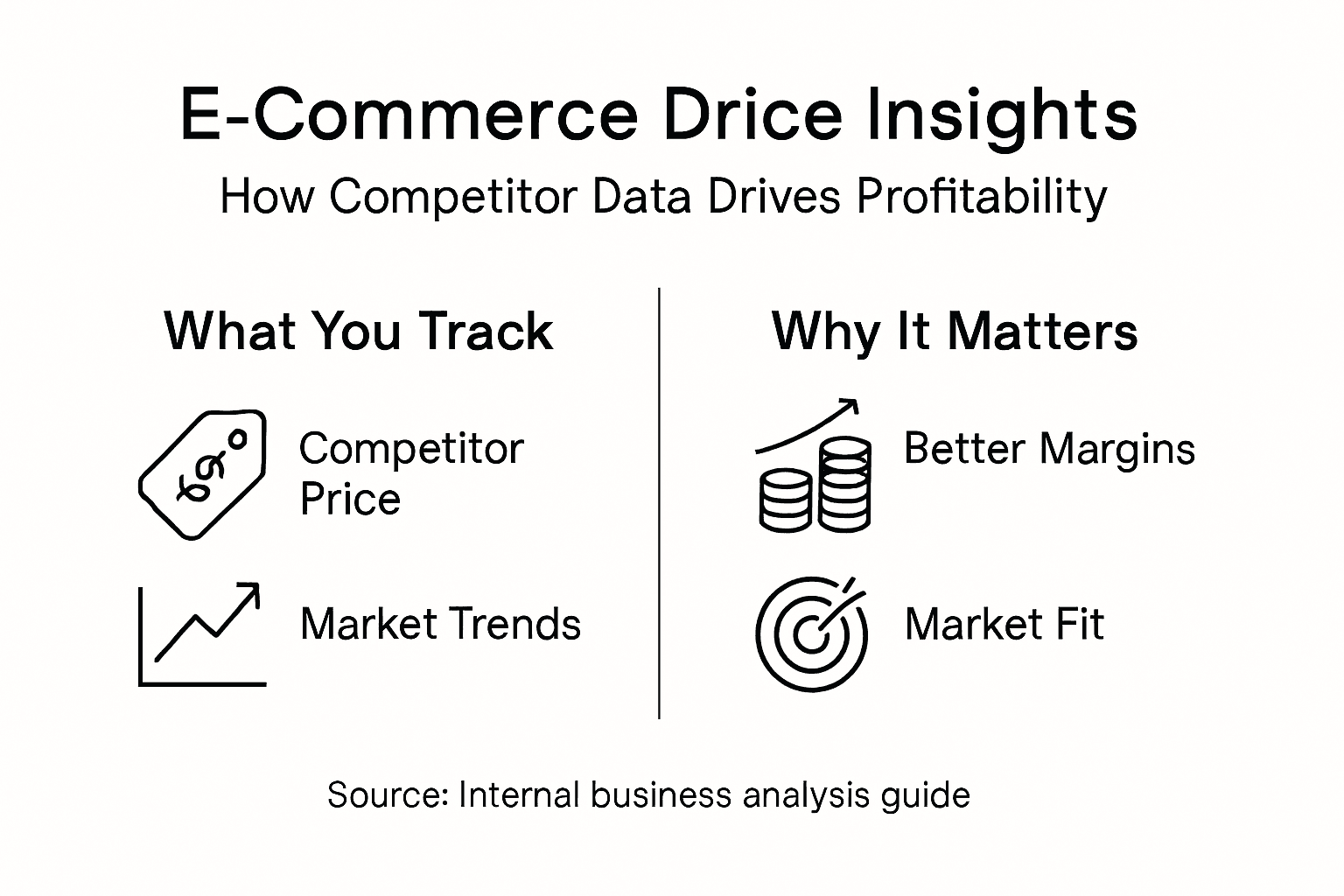
The practical path to profitability integrates competitor insights with internal discipline. Start by calculating your true all-in cost for each product, including direct costs, allocated overhead, payment processing fees, logistics, returns handling, and the cost of customer acquisition. Now you know your profit floor—the absolute minimum price that makes sense. Next, determine what price your target customer will pay based on value perception and alternatives they consider. This is your profit ceiling. Between the floor and the ceiling sits your pricing opportunity. Competitor prices help you understand where the market clusters within that range, but they shouldn't force you outside your range. If all competitors are below your cost floor, you may be in the wrong market or selling the wrong product. If you can price above where competitors cluster because of brand strength or unique features, capture that margin instead of giving it away. The most profitable e-commerce operators aren't necessarily the cheapest; they're the ones who understand their cost structure deeply and price strategically within the boundaries their market allows.
Pro tip: Calculate your contribution margin by product at different price points, then use competitor data to identify which price points deliver both market competitiveness and healthy margins rather than automatically matching the lowest competitor price.
The following table summarizes common e-commerce pricing strategies and when to use each:
| Strategy | Best Used For | Typical Market Role |
|---|---|---|
| Cost-Plus | Commodities, stable demand | Competing primarily on price |
| Value-Based | Differentiated products | Leveraging brand or features |
| Penetration | New market entry | Rapid customer acquisition |
| Skimming | Innovative, new products | Maximizing early profit |
Unlock Profitable Pricing with Competitor Price Tracking
Understanding how competitor prices influence your profit margins and customer behavior is essential for e-commerce success. The article highlights key challenges like staying ahead with real-time pricing adjustments and avoiding costly pricing mistakes while complying with legal guidelines. If tracking competitor prices manually feels overwhelming or you want to harness dynamic pricing strategies without risk, our competitor price tracking for e-commerce solutions have you covered.
Discover how Priceotus can help you capture accurate, up-to-date competitor pricing data with automated tools designed for fast-moving markets. Don't leave profit on the table or fall behind while others adapt. Take control now and optimize your pricing strategy using insights grounded in your unique costs and customer value. Visit competitor price tracking for e-commerce and start turning competitor data into your greatest advantage today.
Frequently Asked Questions
What is competitor price analysis in e-commerce?
Competitor price analysis in e-commerce involves monitoring and evaluating the prices charged by competitors for similar products or services. It goes beyond just noting price changes; it integrates marketing, economics, and operational strategies to inform pricing decisions.
Why is it important to track competitor prices?
Tracking competitor prices is crucial because customers can compare prices across multiple retailers instantly. Understanding competitors' pricing helps businesses set competitive yet profitable prices while avoiding being undercut or losing market share.
What methods can be used to track competitor prices?
You can track competitor prices using manual monitoring methods or automated systems. Manual tracking includes visiting competitor websites and recording prices, while automated tools like web scraping, APIs, and price tracking software can provide real-time data and help identify pricing trends more efficiently.
How does dynamic pricing impact profitability in e-commerce?
Dynamic pricing allows businesses to adjust prices in real-time based on factors like market demand and competitor actions. This approach helps maximize revenue by capturing additional margins when demand increases, while also allowing for price adjustments to drive sales during slow periods.