

- Published on
Marketing Mix Made Simple: Boost Your E-Commerce Brand Effectively
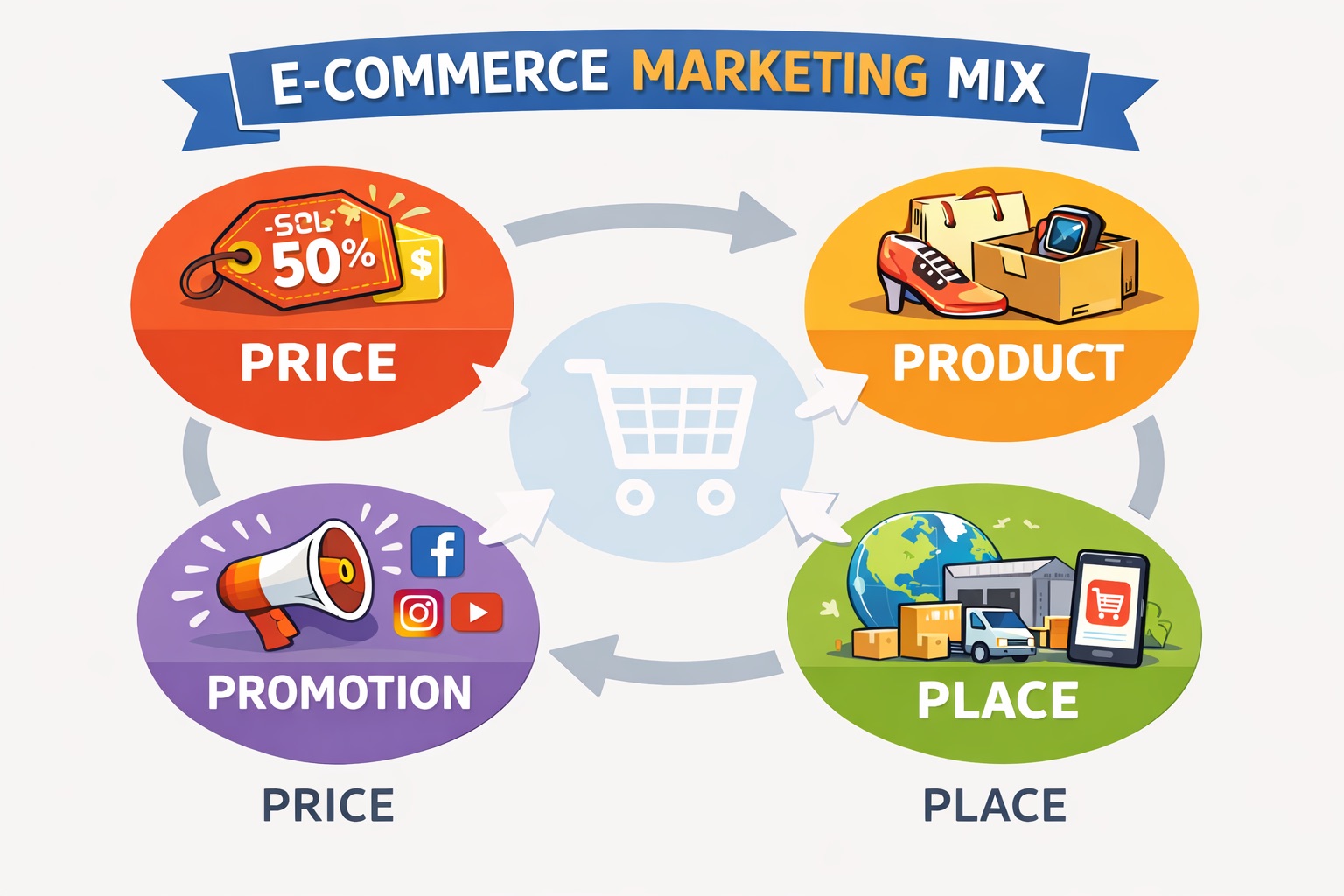
Growth in e-commerce rarely comes from a single channel or tactic. Instead, it’s driven by how well product, pricing, distribution, and promotion work together. The marketing mix offers a clear framework for understanding those relationships and making better decisions as markets, costs, and customer expectations evolve.
This guide explores the marketing mix through the lens of modern e-commerce and DTC businesses, combining established theory with real-world examples, research insights, and a practical checklist.
What is the Marketing Mix?
The marketing mix refers to the set of controllable elements a business uses to influence demand and shape customer experience. Traditionally, it is described through the 4 Ps of Marketing:
- Product – What you sell, including differentiation, assortment, and quality
- Price – What customers pay and how value is perceived
- Place – Where and how customers buy
- Promotion – How awareness and demand are generated
In e-commerce, these elements are highly visible and closely connected. Changes to pricing affect conversion rates, fulfillment speed impacts retention, and promotion efficiency depends heavily on product clarity and trust.
Why the Marketing Mix matters in e-commerce
Online markets are transparent and competitive. Customers can compare prices instantly, read reviews at scale, and switch brands with minimal effort. In this environment, alignment across the marketing mix becomes a key source of advantage.
Studies from McKinsey shows that companies with strong alignment between value proposition, pricing, and customer experience outperform peers in both revenue growth and profitability
For e-commerce brands, this alignment often matters more than adding new channels.
Extending the Marketing Mix: from 4 Ps to 7 Ps
Many e-commerce and DTC brands operate with an expanded version of the framework known as the 7 Ps of Marketing, which adds:
- People – Customer support, founders, creators, community managers
- Processes – Checkout flow, fulfillment, returns, post-purchase communication
- Physical Evidence – Reviews, user-generated content, packaging, website design
These elements are especially important online, where customers can’t touch or try products before buying. It’s no surprise that things like clear service, good reviews, and other trust signals play a huge role — most shoppers naturally look for them before making a purchase.
Product strategy: differentiation over assortment
In crowded e-commerce markets, making your products stand out is usually more important than offering a wide range. Too many options can confuse customers and make it harder for them to decide what to buy, especially if it’s not clear why each product is different. This phenomenon, often called choice overload, is known to lower conversion rates.
Key product insights for e-commerce:
- Clear hero products simplify decision making
- Bundles can increase average order value while reducing choice friction
- Strong product-market fit lowers reliance on paid promotion
Brands with clear product positioning tend to scale more efficiently.
Pricing strategy: anchoring around value
Price is one of the fastest levers to adjust, but it’s also easy to get wrong. Customers don't just look at the number — they evaluate whether the price matches the value they expect to receive. For tips on how to approach competitive price analysis and understand your position in the market, see our related article on the topic.
Effective pricing strategies in e-commerce often share a few key traits:
- Transparent and consistent pricing
- Limited use of discounts
- Promotions tied to specific moments, like product launches, bundles, or retention campaigns
Remember, relying on constant discounts can backfire over time. While short-term sales may spike, frequent promotions can make customers wait for deals, reduce perceived product value, and hurt both margins and brand reputation in the end. Instead, strategic, limited-time offers or value-based pricing tend to support sustainable growth and stronger customer loyalty.
Place: choosing the right channels
For e-commerce brands and merchants, "place" refers to the channels where transactions occur — from your own online store to marketplaces and social commerce platforms. It's worth noting that while selling on a large marketplace can drive discovery, heavy dependence on any single platform carries platform dependency risk, where changes in policies, algorithms, or fees can significantly impact your business’s visibility and sales.
Many successful brands use marketplaces for discovery while prioritizing owned channels for retention and lifetime value.
Promotion: amplifying value, not replacing it
Promotion is often the most visible part of the marketing mix, but its effectiveness depends on the strength of the other elements. In practice, promotion tends to amplify the value a product already offers rather than create value on its own, so it works best when paired with a strong product and clear pricing.
In e-commerce, strong promotion strategies:
- Highlight differentiation
- Reinforce trust through reviews and UGC
- Support retention through email and post-purchase communication
Case insight: aligning the marketing mix in a DTC brand
A growing DTC skincare brand faced rising acquisition costs despite steady website traffic.
Challenges identified:
- Product messaging was too complex, making it unclear which item solved which problem
- Heavy reliance on discounts led customers to wait for deals
- Post-purchase engagement was minimal, reducing repeat sales
Changes implemented:
- Launched a single signature serum as the hero product, with a clear value proposition
- Simplified messaging to focus on the serum’s key benefit: “hydrates and smooths skin in 7 days”
- Replaced constant discounts with bundle offers and post-purchase follow-up emails to encourage repeat orders
Outcome:
- Conversion rate increased by 18% within three months
- Average order value rose by 12% due to bundles
- Paid acquisition spend decreased as organic repeat purchases grew
By simplifying their product offering and focusing on what really matters to customers, the brand didn’t just boost sales, it made shopping easier, showing that even small, thoughtful changes can have a big impact.
Using data to refine the marketing mix
In e-commerce, it’s not enough to guess which marketing actions drive results. Businesses need a structured way to measure the impact of different elements of the marketing mix — product, price, place, and promotion — on sales and customer behavior. This is where Marketing Mix Modeling (MMM) comes in.
What is Marketing Mix modeling?
MMM is a statistical approach used to quantify how each part of the marketing mix contributes to outcomes like revenue, conversion, or customer retention. By analyzing historical data, MMM helps brands understand:
- How changes in pricing affect sales
- Which promotion types generate the most incremental value
- Which channels and placements are most effective
- How different marketing activities interact with each other
Why it matters for e-commerce:
Online retailers have access to vast amounts of data—from website traffic and cart behavior to email performance and ad campaigns. Using MMM or simplified versions of it allows e-commerce merchants to:
- Allocate marketing budgets more efficiently
- Avoid over-investing in channels that don’t drive meaningful results
- Optimize pricing, promotions, and product placement based on real customer behavior
Even without sophisticated models, the principle is the same: track your results, measure incrementality, and make data-informed decisions rather than relying on assumptions or "last-click" metrics alone, while ensuring your pricing aligns with the value you offer and strengthens your market position. This helps e-commerce teams improve ROI and refine the marketing mix over time.
For a practical step-by-step guide to getting started with MMM using your own data, check out this detailed article.
Practical checklist for e-commerce merchants
Product
- Clear hero products
- Strong differentiation
- Bundles or curated sets
Price
- Value-based pricing
- Strategic, limited promotions
- Healthy margins
Place
- Optimized owned store
- Intentional marketplace presence
- Access to customer data
Promotion
- Messaging aligned with value
- Balanced acquisition and retention
- Reviews and UGC integrated
People
- Responsive customer support
- Authentic brand voice
Processes
- Simple checkout
- Clear delivery and returns
- Consistent post-purchase communication
Physical Evidence
- Visible reviews and testimonials
- Trust signals across the site
- Consistent branding and UX
Key takeaways
The marketing mix remains a practical and relevant framework for e-commerce and DTC brands. It helps teams move beyond isolated tactics and focus on how each decision reinforces the overall customer experience.
Sustainable growth comes not from chasing every new channel, but from maintaining alignment across product, pricing, channels, and promotion, and refining that mix over time.