

- Published on
10 Proven Ways to Get Rid of Dead Stock Fast
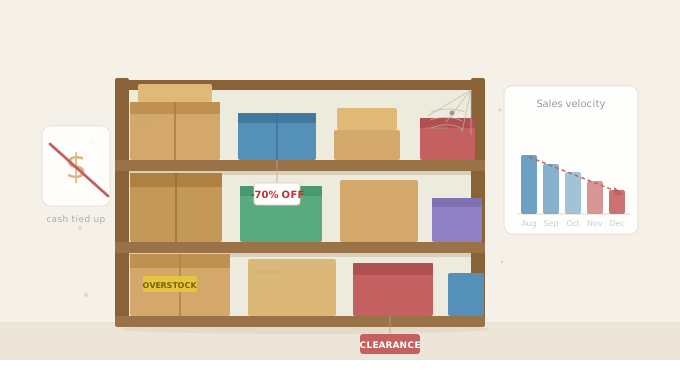
10 Proven Ways to Get Rid of Dead Stock Fast (For E-Commerce Stores)
You placed a bulk order because the margins looked great. The product arrived, you listed it, and... nothing. Weeks turn into months, and that inventory is still sitting there, quietly eating into your cash flow and warehouse space.
Dead stock is one of the most frustrating problems for small and mid-sized e-commerce stores — and it's more common than most people admit. According to IHL Group, retailers globally lose over $1.7 trillion annually to overstocks and returns. For a small store, even a few hundred unsold units can throw off your entire quarter.
The good news? Dead stock is not a dead end. There are real, actionable ways to move it — fast. Here are 10 strategies that actually work, ranked roughly from "easiest to execute" to "last resort."
1. Run a time-limited flash sale
The simplest move is also often the most effective: cut the price and create urgency. A well-timed flash sale — 24 to 72 hours — triggers loss aversion in buyers. They don't want to miss a deal.
Research from the Baymard Institute consistently shows that scarcity and urgency cues (like countdown timers) meaningfully lift conversion rates on product pages. You don't need to slash prices by 70% either. Even a 25–30% discount framed as "limited time only" can get products moving.
Practical tips:
- Email your list first — they're the warmest audience you have
- Pin the sale to the top of your homepage and social profiles
- Use a countdown timer on the product page
- Cap the discount to protect your brand perception — going too low trains customers to wait for sales
2. Bundle dead stock with best-sellers
This is one of the smartest ways to move slow inventory without visibly discounting it. Pair a dead-stock item with a product that already sells well, and price the bundle at a slight discount compared to buying both separately.
A well-known example is how Procter & Gamble uses bundle promotions to introduce or clear slower product lines by attaching them to flagship SKUs. For e-commerce, this translates easily — a slow-selling phone case bundled with a popular screen protector, for instance.
The key is framing. Call it a "starter kit," "gift set," or "value bundle" — not a clearance bundle. Perception matters more than you'd think.
3. List on secondary marketplaces
Your own store isn't the only place to sell. Platforms like eBay, Amazon, Facebook Marketplace, and niche marketplaces (Poshmark for fashion, Reverb for music gear) have buyers actively looking for exactly what you're sitting on.
Each marketplace has a different buyer profile and pricing norm, so don't just copy-paste your store prices. Research what similar products are actually selling for — not just listed for — before you price. Sold listings on eBay, for example, are a goldmine for figuring out real market value.
If you're already selling across multiple channels, make sure your pricing stays consistent and competitive. Our guide on competitive price analysis walks through exactly how to approach this without guessing.
4. Sell in bulk to liquidators or B2B buyers
Sometimes speed matters more than margin. Liquidation companies and B2B bulk buyers exist specifically to take large quantities of unsold inventory off your hands, and fast.
The trade-off is obvious: you'll recover a fraction of your cost. But weigh that against the ongoing cost of storing dead stock (fulfillment center fees, warehouse space, opportunity cost of tied-up capital). For many small stores, liquidating at 20 cents on the dollar is still better than holding inventory for another six months.
Platforms like B-Stock, Liquidation.com, and Direct Liquidation connect sellers with vetted bulk buyers. Before you go this route, set a price floor, the minimum you'll accept, so you don't end up giving product away.
5. Donate it (and get a tax write-off)
Donating unsold inventory to nonprofits, schools, or community organizations is a legitimate business expense in many jurisdictions — and it clears your shelves while doing some good.
In the U.S., the IRS allows businesses to deduct the cost of donated inventory cost basis. That's a real financial benefit, not just a feel-good move.
Beyond the tax angle, product donations can also generate genuine PR and social media goodwill — especially if you document the donation with photos and share the story. Smaller brands often underestimate how much authenticity resonates with their customer base.
Just make sure you get proper documentation from the receiving organization and work with your accountant to record it correctly.
6. Approach your supplier about a return or buyback
This one is underused. Many suppliers — especially if you have an established relationship — are open to negotiating a partial return, an exchange for different SKUs, or store credit toward a future order.
They won't always say yes, and there will likely be restocking fees. But it's worth asking, especially if the dead stock resulted from something outside your control (a trend shift, a supply chain delay that arrived too late, a product defect that affected conversion).
Going forward, try to negotiate return clauses into your supplier contracts before you order. A clause allowing returns of up to 10–15% of an order within 90 days can save you a lot of headaches down the line.
7. Repackage, rephotograph, and remarket
Sometimes the product isn't the problem — the listing is.
Poor product photography, weak copy, or wrong audience targeting can bury a perfectly good product. Before writing something off as dead stock, try relaunching it with better visuals, a rewritten description, and a different positioning angle.
A case study from an apparel brand found that simply re-shooting product photos on a model (versus a flat lay) increased conversion rates by over 30% on the same SKU. For e-commerce, presentation is everything.
Also consider:
- Targeting a different customer segment with paid ads
- Repositioning the product for a different use case
- Moving it to a different category on your site
Run an A/B test on the new listing before scaling ad spend — small changes in title and imagery can make a significant difference.
8. Use dead stock as a free gift or loyalty reward
If you have a loyalty program or regularly run "gift with purchase" promotions, dead stock is perfect fuel for it.
Customers love getting something for free — even if the item has a low perceived cost. Research on reciprocity in consumer behavior (Cialdini's classic work on influence) shows that unsolicited gifts drive stronger brand attachment and repeat purchase rates.
Practically, you can:
- Add dead stock as a free item at a certain cart threshold ("Spend $50, get a free [product]")
- Use it as a referral reward ("Refer a friend and we'll send you a little gift")
- Include it as a surprise in orders — customers sharing unboxing content is free marketing
This approach moves inventory without discounting your brand. It's especially effective for fashion, beauty, and lifestyle stores.
9. Host an internal employee sale
Small and simple, but genuinely effective for moving low volumes quickly. Open up a private sale for your team (and their families, if you're generous) at a steep discount.
Employees are often happy to buy products they believe in at cost or below. Frame it as a "staff exclusive event" rather than a generic discount — it builds a sense of privilege and excitement rather than desperation.
This won't clear 500 units overnight, but it's a zero-cost, zero-effort way to reduce inventory in smaller batches and keep your team engaged.
10. Write it off and learn from it
When all else fails, sometimes the right move is to accept the loss, write off the inventory, and move on.
An inventory write-off removes the unsaleable stock from your balance sheet and reduces your taxable income. It's not a win, but it's a clean one — and it clears mental and physical space to focus on what does sell.
More importantly, treat every write-off as a post-mortem. Ask:
- Was this a forecasting error?
- Did we order too much based on a trend that faded?
- Was the marketing strategy insufficient?
- Did a supplier delay make the product arrive out of season?
Documenting the answer builds institutional knowledge that prevents the same mistake from recurring. Over time, that's worth more than the inventory itself.
How to stop dead stock from building up again
Clearing dead stock is a short-term fix. Preventing it is the real goal.
The most common root cause is inaccurate demand forecasting — ordering based on gut feel rather than data. A few habits that help:
- Audit slow-moving SKUs monthly. Don't wait until something is dead — catch it while it's just slow and you still have options.
- Order smaller quantities more frequently when possible, even if the unit economics are slightly worse. Flexibility often outweighs bulk savings.
- Watch your competitors' pricing and stock signals. If competitors start discounting a product category heavily, that's often an early signal of softening demand. Tools like PriceOtus let you track competitor prices and stock changes automatically — which can give you a heads-up before you're stuck with excess inventory.
- Set reorder thresholds based on actual sell-through rates, not optimistic projections.
Final thoughts
Dead stock happens to almost every e-commerce store at some point. The difference between stores that recover quickly and those that don't is usually speed — the faster you act, the more options you have and the more value you can recover.
Start with the strategies that require the least effort (flash sales, bundling, marketplace listings) and work your way down the list. Don't hold out for full-price recovery on inventory that isn't moving — some revenue is always better than none.
And once you've cleared it, put systems in place so you're not back in the same position six months from now.
Frequently asked questions
What is the fastest way to get rid of dead stock?
Flash sales and marketplace listings (eBay, Amazon) are typically the fastest options. They require minimal setup and reach buyers who are already looking for the product.
Can dead stock be written off on taxes?
Yes. In most jurisdictions, unsellable or donated inventory can be written off as a business expense. Consult your accountant to ensure it's recorded correctly.
What's the difference between dead stock and slow-moving inventory?
Slow-moving inventory sells — just slowly. Dead stock has effectively stopped selling altogether and has little realistic chance of selling at its current price or positioning without intervention.
How do I prevent dead stock in the future?
Better demand forecasting, smaller more frequent orders, regular SKU audits, and monitoring competitor pricing trends are the most effective preventive measures.
Is liquidation worth it?
It depends on your carrying costs. If the cost of storing inventory (fees, space, opportunity cost) exceeds what you'd recover through liquidation, then yes — liquidating at a low price is often the rational move.