

- Published on
What Is a Price Point? How to Choose the Right One for Maximum Profit
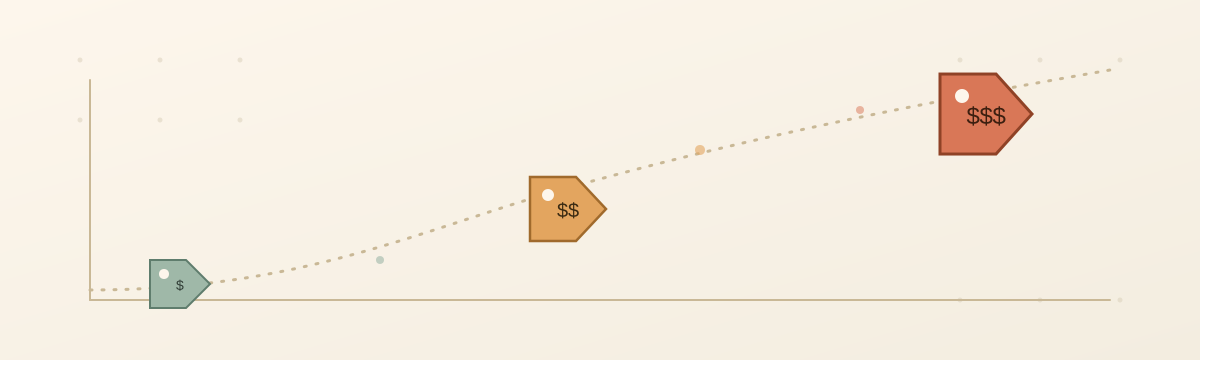
What is a price point and why it quietly decides whether your store makes money
If you sell anything online, you've probably typed a number into a price field, stared at it, then changed it three times before hitting save. That instinct is worth paying attention to, because the price point you land on does more work than almost any other decision in your store - more than the product photos, sometimes more than the product itself.
A price point isn't just "the price." It's the specific number on the scale of everything you could charge that balances what customers will actually pay against what keeps your margins alive. Get it right and you sell more units at a profit that funds growth. Get it wrong and you either leave money on the table or watch your add-to-cart rate quietly die.
This guide covers what a price point actually is, the psychology and math behind setting one, and the strategies merchants use to find - and defend - the right number.
Price point vs. price: a distinction worth keeping straight
These two terms get used interchangeably, but they're not the same thing.
- Price is the actual number a customer pays right now - the figure on the product page.
- Price point is the strategic position that price occupies on a curve of possible prices, tied to demand, competition, and how the market perceives your brand.
Think of it this way: $49.99 is a price. The decision to sit just under the $50 psychological threshold, in the "accessible premium" tier rather than "budget" or "luxury," is the price point. Price point refers to the strategic process of determining how to price a product by carefully analyzing market variables, while plain price is just the resulting number on the tag.
That distinction matters because every price point you set sends a signal about who the product is for - you're not just picking a number, you're picking a position in the market.
Why price points are not random
If you've ever priced a product by glancing at three competitors and landing somewhere in the middle, you're not alone - and you're probably leaving money on the table. Most sellers don't bother with retail pricing strategies too much; they simply point toward a median value of competitors' prices, and that approach rarely produces strong results on its own.
A defensible price point usually accounts for:
- Production and landed cost - the floor below which you lose money on every sale
- Perceived value - what the product feels worth to the buyer, independent of cost
- Competitive pricing - what alternatives are charging for something comparable
- Target segment - who you're selling to and what they're used to paying
- Demand sensitivity - how much a price change actually moves units sold
Skip any one of these and the number you land on is a guess dressed up as a strategy.
The psychology behind the number: why $19.99 isn't really about the price
Here's where price points get genuinely interesting, because a huge amount of buying behavior is driven by how a number looks, not just what it is.
The left-digit effect. People scan a price and anchor on the first digit, then mentally round from there. When shoppers see a price like $9.99, their brain anchors on the 9 rather than rounding up to 10, making the item appear more affordable - even though the actual difference is a single cent. This is why "charm pricing" (prices ending in .99, .95, or .9) is everywhere in retail.
It's been tested, not just theorized. In a well-known field experiment run jointly by researchers at MIT and the University of Chicago, identical women's dresses were priced at $34, $39, and $44. The $39 price outperformed the other two - customers picked the 9-ending price even when it wasn't the lowest option, which tells you the ending digit did more persuasive work than the actual discount.
The effect shows up at scale, too. A frequently cited analysis found charm pricing increases sales by at least 24%, with some consumer psychology research linking it to lifts as high as 60% in specific contexts. Walmart's own internal testing reportedly found a similar pattern: items priced at $4.99 outsold the same items priced at $5.00.
But it's not free of trade-offs. Round numbers (think $50 instead of $49.95) tend to signal quality and confidence, which is why luxury brands tend to avoid the ".99 look" - odd endings can read as "discount," the opposite of the story a premium brand wants to tell. The choice between a charm price and a round price is really a choice about what story the number should tell.
A few related psychological techniques worth knowing:
- Anchoring - showing a higher "was" price next to the current one so the new number looks like a deal by comparison
- Price bundling - packaging items together so individual unit prices become harder to compare
- Decoy pricing - adding a deliberately unattractive third option to make your target price point look like the obvious choice (The Economist's famous three-tier subscription test is the textbook example here)
Price elasticity: the math underneath the psychology
Psychology explains how a price feels. Elasticity explains how a price actually moves units.
Price elasticity of demand measures how sensitive customers are to price changes - higher prices generally make people buy less, lower prices make them buy more, but the size of that swing varies enormously by category and brand.
A few things shape how elastic your demand really is:
- Substitutes - the easier it is to buy the same thing elsewhere, the more elastic your demand
- Brand trust - roughly 46% of consumers say they're willing to pay more for brands they trust, a real buffer against price sensitivity
- Necessity vs. discretionary - luxury goods tend to show inelastic demand because buyers will pay a premium for prestige, while everyday essentials tend to be more price-sensitive
- Customer segment - a college student is typically far more price-sensitive about a streaming subscription than a working professional would be
This is also where ecommerce gets a twist physical retail doesn't have. Online sellers can buy more traffic or spend more on marketing to push quantity up instead of cutting price, which complicates the classic elasticity model - you have more levers than a brick-and-mortar shop ever did, which makes testing more valuable, not less.
The practical takeaway: don't treat your price point as fixed once you find a number that "works." A field study with a large internet retailer found that systematically testing and adjusting price based on elasticity data lifted contribution margin per visitor by roughly 7% - without changing the product at all.
Three classic approaches to setting your price point
Most merchants end up gravitating toward one of three philosophies, sometimes blending all three depending on the product line.
1. Cost-plus pricing Take your unit cost, add the margin you need, done. It's the simplest method, easy to implement, but its main weakness is that it only accounts for internal costs and ignores what's actually happening in the market.
2. Competitor-based pricing You price relative to what similar sellers charge - slightly under, matching, or strategically above. This works, but only if you're tracking those competitors continuously, since a static snapshot goes stale within days.
3. Value-based pricing You price according to what the product is worth to the customer, not what it cost you to make. This is how premium and DTC brands justify higher price points - the product solves a bigger problem, so the number reflects that, not the bill of materials.
Most healthy ecommerce pricing strategies blend all three: a cost floor you never go below, a competitive band you stay aware of, and a value story that lets you sit above the cheapest option without losing the sale.
Where competitor monitoring fits in
Here's the uncomfortable truth about competitor-based pricing: doing it manually doesn't scale. 94% of shoppers compare prices while making a purchase decision online, which means your price point is being benchmarked against rivals constantly, whether you're watching or not.
Big players already treat this as infrastructure, not a side task. One pricing-data analysis found Amazon made over 116,000 price changes in a single tracking period - 69% more than its nearest competitor. That's not a team refreshing tabs; that's automated monitoring feeding a pricing engine in real time.
You don't need Amazon's scale to benefit from the same idea. Tools built for merchants - like PriceOtus, a competitor price monitoring and repricing platform for Shopify and WooCommerce stores - track what rivals charge across marketplaces like Amazon, eBay, Walmart, and Google Shopping and, alert you when a competitor's price moves, and can apply repricing rules automatically so your price point never drifts while you're busy running the rest of the business. For a small or mid-sized brand, that's the difference between reacting to a Black Friday cut two weeks late and adjusting within hours.
Worth asking before picking any monitoring approach:
- How often do prices in your category actually change - daily, weekly, seasonally?
- Are you tracking the right competitors, or just the easiest ones to find?
- Do you want alerts only, or automated repricing within guardrails you set?
Segmenting price points across a product line
Few brands sell at a single price point - and they shouldn't. A clothing brand, for example, will typically run lower-priced staples to bring in budget-conscious shoppers alongside premium pieces for customers happy to pay more for design or materials. Each tier does a distinct job:
- Entry-level price point - low friction, brings new customers in, often a loss-leader or break-even item
- Core price point - your highest-volume, best-margin sweet spot
- Premium price point - smaller volume, but protects brand positioning and pulls up average order value
This kind of tiering also hedges against elasticity risk. If your core price point ever needs to move because of cost inflation, entry and premium tiers give customers somewhere to land instead of just bouncing.
Common mistakes merchants make with price points
A few patterns show up again and again across ecommerce stores:
- Setting price once and never revisiting it. Costs, competitors, and demand all shift; a price point that worked in January can quietly become unprofitable by summer - and a stale price is one of the quieter ways products turn into dead stock before anyone notices.
- Copying the median competitor price without context. If your costs, brand, or service are different, the "average" price isn't necessarily your right price.
- Ignoring shipping and tax in the comparison. A competitor's headline price can look lower while their landed cost is actually higher - or vice versa.
- Treating every SKU the same way. A flagship product and a slow-moving accessory rarely deserve the same pricing logic.
- Panic-discounting after one competitor price cut. One data point isn't a trend; check whether it's a clearance or a real strategy shift before matching it.
A simple framework for finding your price point
If you're starting from scratch or revisiting a stale price, this sequence tends to work well:
- Calculate your cost floor - know exactly what you can't go below and still turn a profit (see marginal-cost pricing if you want the math behind that floor)
- Map the competitive range - find the low, middle, and high end of what similar products charge
- Decide your positioning - budget, mid-market, or premium - and let that guide where in the range you sit
- Test a charm vs. round price - run both for a defined period and compare conversion, not just margin
- Watch elasticity, not just sales totals - a price cut that doubles units but halves margin per unit might be a net loss
- Automate the parts that don't need a human - competitor tracking and repricing rules free you up to focus on positioning, not spreadsheet-watching
Final thought
A price point is never really "finished." It's a live hypothesis about what customers will pay, constantly tested by competitors, cost changes, and shifting demand. Merchants who treat pricing as a one-time decision drift into either underpricing (starving margins) or overpricing (starving conversion). The ones who treat it as an ongoing, data-informed process - backed by real competitor visibility - keep finding a little more margin without losing a sale.
FAQ
What exactly is a price point in simple terms? A price point is the specific price you set for a product, chosen strategically based on cost, competition, customer demand, and brand positioning - rather than picked at random.
What's the difference between price and price point? Price is just the number on the tag. Price point is the strategic reasoning behind why that number was chosen, and where it sits relative to competitors and customer expectations.
Why do so many prices end in .99? It's called charm pricing, and it works because of the left-digit effect - shoppers mentally anchor on the first digit they read, so $9.99 reads as closer to "9" than "10," even though the real gap is one cent.
Does charm pricing always work better than round numbers? Not always. Charm pricing tends to boost conversion for budget and mid-market products, but round numbers often perform better for premium or luxury items, where a ".99" ending can undercut the perception of quality.
How do I know if my price point is too high or too low? Watch your conversion rate alongside margin, not in isolation. A price that's too high usually shows up as healthy margin but weak add-to-cart and checkout rates; a price that's too low shows strong volume but thin or negative margin once costs are factored in.
How often should I review my price points? At minimum, whenever your costs change, a major competitor shifts pricing, or seasonal demand changes. Many ecommerce brands review core SKUs monthly and let automated tools flag anything that needs faster attention.
Can competitor price monitoring really make a measurable difference? Yes - it's one of the more reliably proven levers in ecommerce pricing. Field studies on systematic price testing and elasticity-based adjustment have shown measurable margin gains without any change to the product itself, and tools like PriceOtus exist specifically to make that kind of monitoring automatic rather than manual.
Should every product in my store have the same pricing strategy? No. It's common - and usually smart - to run different price points across a single product line: an entry-level tier to attract new customers, a core tier that drives most of your volume, and a premium tier that protects brand positioning.